
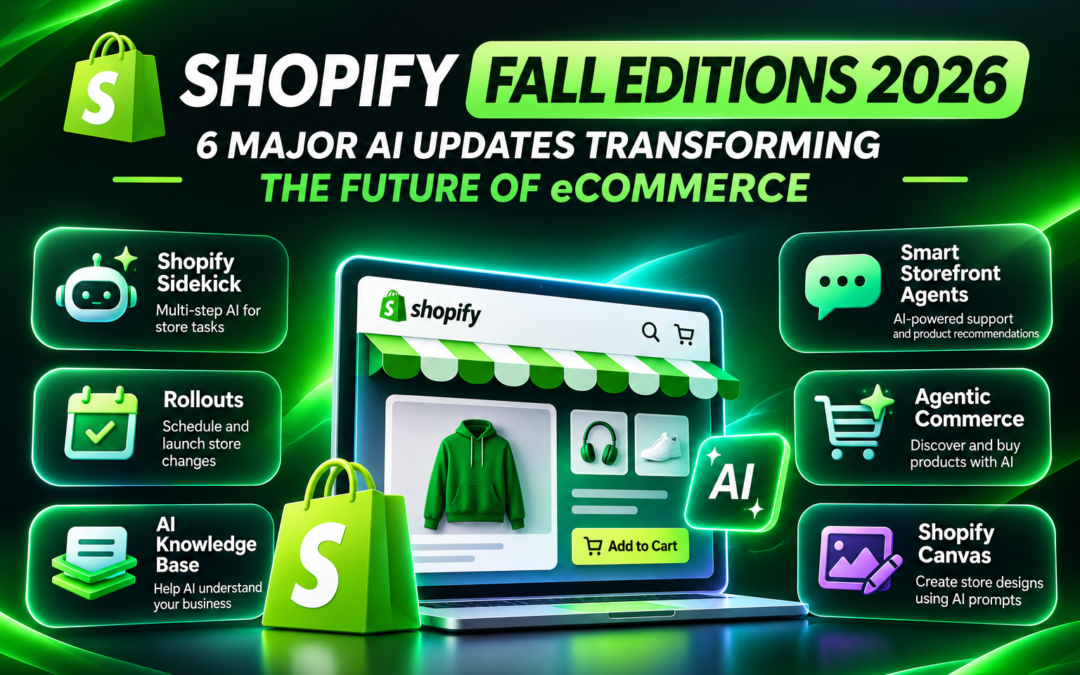
Shopify Fall Editions 2026: 6 Powerful AI Updates That Could Change eCommerce Forever
The future of eCommerce is changing faster than ever, and Shopify is taking a major step toward AI-powered online shopping.
With more than 150 updates announced as part of Shopify Fall Editions 2026, the platform is introducing new capabilities designed to simplify store management, automate repetitive tasks, improve customer experiences, and transform how people discover and purchase products.
From AI assistants that manage multiple store operations to shopping experiences where customers may not even need to visit a traditional website, these developments could significantly reshape the eCommerce industry.
For Shopify merchants, developers, and growing online businesses, understanding these changes is essential.
At The Jiva Infotech, we help businesses build, customize, and optimize Shopify stores. In this article, we explore six major updates highlighted in Shopify Fall Editions 2026 and what they could mean for your business.
1. Shopify Sidekick: AI That Can Complete Multiple Tasks From One Prompt
Shopify Sidekick is evolving from a conversational AI assistant into a more capable tool for managing store operations.
Previously, merchants often needed to provide multiple instructions to complete a workflow. The updated Sidekick experience introduces multi-step task execution, allowing merchants to request several connected actions through a single prompt.
What Can Shopify Sidekick Do?
Imagine asking Sidekick:
“Research trending coffee products, create a new collection, design a promotional banner, and generate a 20% discount code for that collection.”
Instead of manually performing each task, Sidekick can work through the requested steps, prepare changes, and present them for review.
Potential applications include:
- Researching product trends
- Creating product collections
- Generating promotional banners
- Preparing discount codes
- Making supported store changes
- Reviewing multiple changes before publishing
Why Does This Matter?
For small and medium-sized businesses, creating promotional campaigns often involves coordinating design, merchandising, and store administration.
Multi-step AI assistance can reduce repetitive work and help merchants launch campaigns more efficiently.
However, AI-generated changes should still be reviewed carefully before publication, especially when discounts, product information, or customer-facing content are involved.
The Jiva Infotech Insight: Shopify Sidekick can accelerate routine operations, while experienced Shopify developers remain valuable for advanced functionality, custom integrations, and complex store requirements.
2. Shopify Rollouts: Schedule Store Changes Automatically
Launching a new product, preparing for Black Friday, or running a limited-time promotion often requires several coordinated website updates.
Shopify Rollouts introduces a way to prepare supported changes in advance and schedule when they should become active.
How Shopify Rollouts Works
Merchants can create a rollout for a product launch or promotional event, select the relevant changes, and schedule publication.
Depending on the supported configuration, these changes may include:
- Publishing a different Shopify theme
- Activating or removing discounts
- Adjusting product catalog settings
- Applying checkout-related changes
- Scheduling campaign start and end dates
- Targeting selected markets or customer segments
For example, an online fashion brand preparing for Black Friday could configure its promotional theme and discounts ahead of time rather than making every change manually at midnight.
Benefits for Shopify Merchants
Better campaign planning: Prepare promotional experiences before the launch date.
Reduced manual work: Minimize the need to publish individual changes at specific times.
Improved consistency: Coordinate multiple campaign elements through a planned rollout.
More flexibility: Configure supported changes for particular audiences or markets.
For businesses managing frequent promotions, scheduled rollouts could become an important operational tool.
3. Shopify AI Knowledge Base: Help AI Understand Your Business
One of the most significant developments in modern eCommerce is the growing role of AI-powered product discovery.
Customers are increasingly exploring products through conversational tools rather than relying exclusively on traditional search engines.
Shopify’s AI Knowledge Base is designed to help merchants organize and provide information about their businesses for supported AI experiences.
What Is the Shopify AI Knowledge Base?
The Knowledge Base allows merchants to review and manage information about their stores, including:
- Business descriptions
- Product and brand information
- Store policies
- Frequently asked questions
- Additional facts about products and services
Merchants can review suggested information and publish approved details.
Why Is This Important for AI Shopping?
Consider a customer asking an AI assistant:
“Which coffee concentrate is suitable for making iced coffee at home?”
An AI system needs reliable product information to provide a relevant recommendation.
Clear descriptions, accurate FAQs, and structured business information can help supported AI systems better understand what a store offers.
However, publishing information in a Knowledge Base does not guarantee that an AI platform will recommend a particular brand.
Best Practices for Shopify Merchants
Businesses should focus on accurate, useful information that answers real customer questions.
For example, a skincare store might include:
- Which products are suitable for different skin types?
- What ingredients are included?
- How should customers use each product?
- What is the return policy?
- How long does shipping usually take?
The Jiva Infotech Insight: AI discoverability should complement traditional SEO, not replace it. Merchants should continue investing in technical SEO, structured data, high-quality product content, and strong website performance.
4. Smart Storefront Agents: AI-Powered Customer Support and Product Recommendations
Customer support is another area where Shopify is introducing more advanced AI capabilities.
The updated Shopify Inbox experience, highlighted through Smart Storefront Agents, aims to help customers receive relevant answers and personalized product recommendations through conversational interactions.
How Smart Storefront Agents Work
Instead of relying entirely on human support agents, merchants can configure an AI-powered assistant to help shoppers navigate their stores.
For example, a customer might ask:
“I’m looking for a coffee product that is easy to prepare and suitable for iced drinks. What would you recommend?”
The assistant can use available store information to suggest relevant products.
The demonstrated experience also includes the ability to begin checkout through a chat interaction.
Key Capabilities
- Answering common customer questions
- Providing personalized product suggestions
- Helping shoppers discover relevant products
- Supporting chat-based shopping journeys
- Configuring brand tone and communication style
- Allowing customers to reach human support when needed
Business Benefits
A properly configured AI assistant may help reduce repetitive support requests, improve product discovery, and assist customers outside normal support hours.
For merchants receiving frequent questions about product specifications, availability, or shipping policies, this can be particularly valuable.
Nevertheless, businesses should test responses, verify accuracy, and maintain human support options for complex customer issues.
5. Shopify Agentic Commerce: Shopping Without Visiting a Traditional Storefront
Perhaps the most transformative update discussed in Shopify Fall Editions 2026 is Agentic Commerce.
Traditionally, customers discover products through search engines, advertisements, social media, or marketplaces before visiting a website to make a purchase.
Agentic Commerce introduces a different possibility.
Customers can interact with supported AI assistants to discover products and move toward checkout without manually browsing every merchant website.
How Does Agentic Commerce Work?
Imagine a customer opening an AI assistant and typing:
“Find a high-quality coffee concentrate and help me buy it.”
A supported AI shopping integration could search available product catalogs, identify relevant options, and help the customer prepare a checkout.
In the video demonstration, a Claude integration connected with Shopify’s Shop experience to discover products and prepare a checkout for payment approval.
This illustrates how AI-assisted shopping can reduce the steps between product discovery and purchase.
Does This Mean Shopify Websites Will Disappear?
Not necessarily.
Although AI agents may change how customers discover and purchase products, a professional storefront continues to serve important business functions.
A website provides:
- Brand identity and differentiation
- Product storytelling
- Custom shopping experiences
- Customer trust and credibility
- Organic search visibility
- Direct customer relationships
- Marketing campaign destinations
- Advanced functionality and integrations
The more realistic possibility is that AI-assisted purchasing becomes an additional sales channel alongside traditional websites.
What Should Merchants Do?
Shopify merchants should begin preparing for AI-driven product discovery by maintaining accurate product data, clear descriptions, updated policies, and well-organized catalogs.
Businesses should also continue developing recognizable brands that customers can trust, regardless of where a purchase begins.
The Jiva Infotech Insight: The future of eCommerce may involve both traditional storefronts and AI-powered shopping interfaces. Businesses that prepare for both experiences will be better positioned to adapt.
6. Shopify Canvas: Build Store Designs Using AI Prompts
Store design and development are also changing with the introduction of Shopify Canvas, as demonstrated in the video.
The concept is straightforward: merchants describe the visual direction they want, and AI generates a store design using available business and product information.
How Shopify Canvas Works
A merchant might enter a prompt such as:
“Create a playful and colorful online store with modern typography, engaging product sections, and a clean shopping experience.”
The demonstrated Canvas workflow uses Sidekick and store information to generate a design that includes multiple storefront elements.
These may include:
- Homepage layouts
- Product page designs
- Collection page layouts
- Typography selections
- Color palettes
- Product imagery
- Promotional sections
- AI-generated visual assets
Merchants can then request changes through additional prompts.
Will AI Replace Shopify Developers?
AI-generated storefronts can dramatically simplify initial design creation, but producing a visual layout is only one part of building a successful eCommerce business.
Professional Shopify development may still be required for:
Custom Shopify Liquid development: Creating advanced theme sections and tailored storefront functionality.
Third-party integrations: Connecting Shopify with CRM, ERP, fulfillment, subscription, and other business systems.
Performance optimization: Improving loading speed, Core Web Vitals, and mobile usability.
Conversion rate optimization: Refining product pages, shopping journeys, and cart experiences.
Complex business requirements: Developing features that standard AI-generated layouts may not fully support.
Testing and maintenance: Ensuring the store remains functional, accessible, and reliable across devices and updates.
AI tools can accelerate design and development workflows, while experienced developers help turn those outputs into reliable, production-ready commerce experiences.
What Do These Shopify Updates Mean for eCommerce Businesses?
Together, these six developments suggest that Shopify is moving toward a more AI-assisted commerce ecosystem.
| Shopify Update | Potential Business Impact |
|---|---|
| Multi-step Sidekick | Faster execution of routine store tasks |
| Shopify Rollouts | More efficient campaign scheduling |
| AI Knowledge Base | Better organization of information for AI experiences |
| Smart Storefront Agents | Conversational customer assistance |
| Agentic Commerce | Additional AI-powered shopping journeys |
| Shopify Canvas | Faster AI-assisted storefront design |
The common theme is automation.
Shopify is introducing tools that could reduce manual work and make sophisticated eCommerce capabilities more accessible to merchants.
However, successful adoption will depend on implementation quality, data accuracy, compatibility, and the needs of each individual business.
How to Prepare Your Shopify Store for AI-Powered Commerce
Businesses do not need to rebuild their entire online presence to begin preparing for these changes.
A practical starting point is to evaluate existing store operations and identify opportunities for improvement.
Step 1: Optimize Product Information
Ensure product titles, descriptions, images, specifications, and policies are complete and accurate.
Step 2: Improve Your Store’s Technical Foundation
Maintain fast loading speeds, mobile responsiveness, clean navigation, and reliable checkout functionality.
Step 3: Build a Useful FAQ Library
Answer the questions customers frequently ask before making a purchase.
Step 4: Explore AI Automation
Test supported Shopify AI capabilities in a controlled environment before applying changes to your live store.
Step 5: Strengthen Your Brand Experience
Continue investing in design quality, trust signals, content, and a consistent brand identity.
Step 6: Work With Experienced Shopify Professionals
For advanced customizations, integrations, and performance improvements, professional technical support can help ensure new capabilities are implemented correctly.
How The Jiva Infotech Can Help Your Shopify Business
At The Jiva Infotech, we specialize in helping eCommerce businesses create and improve professional Shopify experiences.
As Shopify continues introducing AI-powered capabilities, our focus remains on building stores that combine modern technology with practical business requirements.
Our Shopify development services include:
- Custom Shopify Store Design and Development
- Shopify Theme Customization
- Shopify Liquid Development
- Shopify Speed and Performance Optimization
- Shopify App and API Integrations
- Shopify Store Migration
- Shopify Conversion Rate Optimization
- Ongoing Shopify Maintenance and Support
Whether you are launching a new Shopify store, improving an existing website, or exploring AI-powered commerce, our team can help you plan and implement the right technical solutions.
Frequently Asked Questions
1. What is Shopify Fall Editions 2026?
Shopify Fall Editions 2026 is a collection of platform updates covering store management, AI-powered tools, shopping experiences, and commerce development.
2. Can Shopify Sidekick create product collections and discounts?
The multi-step Sidekick experience demonstrated in the video can prepare product collections, promotional assets, and discount configurations from a connected set of instructions, subject to review.
3. What is Shopify Agentic Commerce?
Agentic Commerce refers to shopping experiences where supported AI assistants help customers discover products and move toward purchases through connected commerce systems.
4. Can customers purchase Shopify products without visiting the merchant’s website?
Supported AI shopping experiences may allow customers to discover products and prepare checkout without manually browsing the merchant’s storefront. The exact payment process depends on the integration.
5. Can Shopify Canvas create an entire store?
The demonstrated Shopify Canvas experience can generate multiple storefront designs and layouts using AI prompts and existing store information. Businesses should still review and test generated outputs before publishing.
6. Will AI replace Shopify developers?
AI can automate many routine design and administrative tasks, but custom development, complex integrations, technical optimization, and quality assurance remain important for professional eCommerce operations.
7. How can I prepare my Shopify store for AI shopping?
Start by improving product information, organizing FAQs, maintaining accurate store policies, optimizing technical performance, and evaluating supported AI commerce features.
Final Thoughts: The Future of Shopify Is AI-Powered
Shopify Fall Editions 2026 highlights an important shift in eCommerce.
AI is becoming more deeply integrated into how online stores are designed, managed, discovered, and used by customers.
From Sidekick’s multi-step automation to Agentic Commerce and AI-assisted storefront creation, these developments could make online selling more efficient while creating new opportunities for businesses.
But technology alone does not guarantee eCommerce success.
A strong brand, reliable website, clear product information, excellent customer experience, and thoughtful technical implementation will continue to matter.
Businesses that combine AI-powered capabilities with a strong eCommerce foundation will be better prepared for the next generation of online shopping.
Ready to Upgrade Your Shopify Store?
Build a smarter, faster, and more powerful Shopify experience with The Jiva Infotech.
Whether you need a custom Shopify store, advanced Liquid development, performance optimization, or ongoing technical support, our team is ready to help.
Visit: https://thejivainfotech.com/
The Jiva Infotech — We Build Stores That Sell!